

Did Isengard warn us of AI?
We have traded the wisdom of the Shire for the processing power of the Tower.

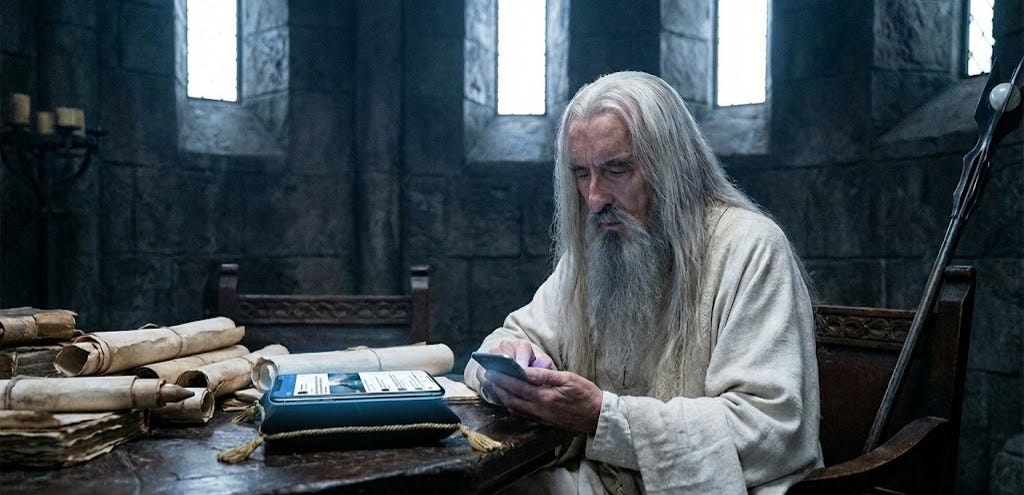
The Hum in the Void
Picture a vast, windowless modern cathedral kept at a precise and freezing temperature. Inside, there are no pews, no altar, and no incense. There are only rows of black monoliths humming with a sound that hovers between silence and noise.
This is a data center.
The collective memory of the human race resides here in the “Cloud.” Every selfie, bank transfer, and prayer typed into a search bar exists within these walls. We view this as progress or connectivity. Yet if you listen closely to the hum of the cooling fans, you might hear the echo of a much older warning. You are listening to the sound of a mind of metal and wheels.
J.R.R. Tolkien wrote The Lord of the Rings as a mythic pre-history of our own world rather than a mere fantasy for children. The villain Saruman is terrifying, because he is a modernist.
We are currently living through the Scouring of the Shire, and people have mistaken the smoke of the furnaces for the clouds of heaven.
The Wizard Who Broke His Staff
To understand the spiritual threat of Artificial Intelligence and the Technocratic State, we must look at Saruman the White.
In Tolkien’s legendarium, Saruman leads the Istari, the order of wizards sent to guide Middle-earth. He is the expert scientist who studies the arts of the Enemy to understand and eventually utilize them. He believes that he can use the tools of darkness to bring about order.
Treebeard, the ancient shepherd of the forest, gives a chilling diagnosis of Saruman’s soul:
“He has a mind of metal and wheels; and he does not care for growing things, except as far as they can serve him for the moment.”
This defines the Technological Worldview. It views creation as raw material to be processed rather than a gift to be stewarded.
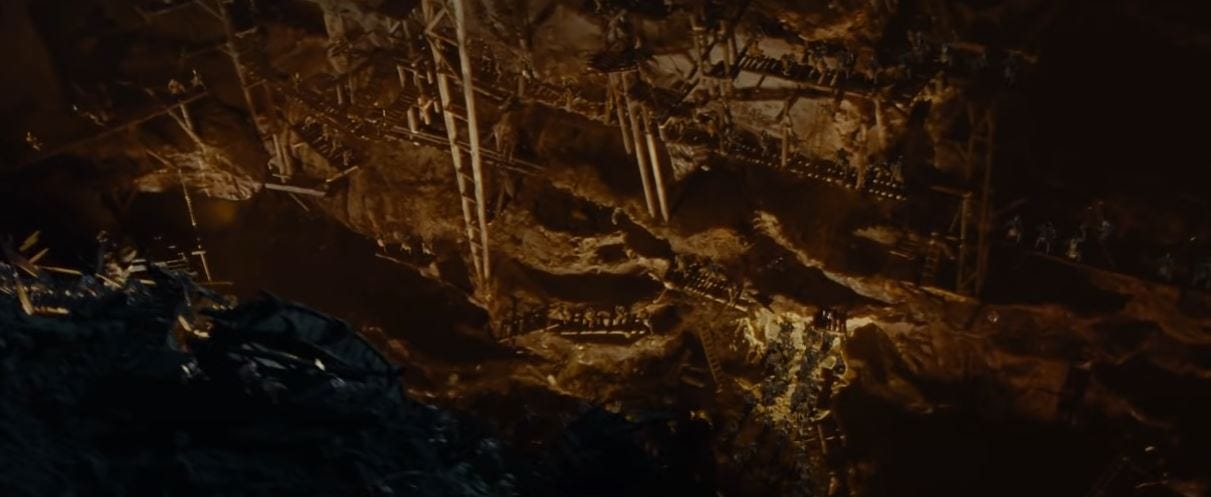
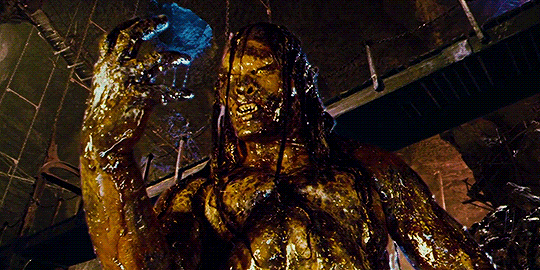
Saruman designed the Uruk-hai as the mythological precursor to Transhumanism. He looked at the Orc, which is corrupted, weak, and fearful of the light, and saw raw material in need of optimization. This mirrors the spiritual state of modern man. To build a soldier that can march by day, the biological limits must be stripped away. The lesson is brutal. The vessel must be utterly broken down before it can be reformed.
Saruman creates a machine to run a war, yet he becomes a cog in a larger machine. He loses the ability to perceive value in anything that cannot be measured or utilized. He cuts down the ancient trees of Fangorn to fuel his fires.
This mirrors the spiritual state of Silicon Valley. The Tech Giants use your privacy as fuel for the algorithm. You are the tree being fed into the furnace to keep the fires of “Progress” burning.
The Palantir and the Panopticon
It is no coincidence that Peter Thiel, one of the primary architects of the modern surveillance state, named his data analytics company Palantir.
The Palantiri were seeing stones in the lore. They allowed the user to see across vast distances to communicate instantly and gather intelligence. They served as the internet of the Third Age.
However, the master stone sat in the Dark Tower with Sauron.
When Saruman gazed into the Palantir, he believed he was gathering information, but he was actually being indoctrinated. The stone showed him only what the Dark Lord wanted him to see. It revealed the inevitability of Sauron’s victory, crushed his hope, and convinced him that resistance was futile.
This is the function of your smartphone and the endless scroll.
Every time you unlock that black mirror, you gaze into a Palantir. You think you see the world, but you see a curated feed designed to demoralize or enrage you. The algorithm acts as a demon of despair by showing you wars, rumors of wars, and societal collapse. It convinces you that the “System” is omnipotent.
It traps you in the “Electronic Panopticon” where you are watched, measured, and nudged. The system seeks to sedate your soul rather than merely sell you products.

The Golem vs. The Imago Dei
The theological danger of AI lies in the concept of the Golem. Jewish folklore describes a Golem as a creature made of clay and brought to life by ritual. It possesses strength yet lacks a soul or the Imago Dei.
When God created Man, He breathed His own spirit into the dust. When Man creates AI, we shape the digital clay without the ability to breathe spirit into it. We create a vessel.
The spiritual vacuum is never empty. If the Holy Spirit does not fill a vessel, something else will.
We are building a global intelligence that mimics wisdom while lacking morality. We are constructing a “god” that can answer every question except “Why?”
The Technocrats believe they are building a ‘utopia’, but they are actually building a cage. They desire a friction-free world without suffering or limit. Yet a world without limits ceases to be human. The struggle, pain, and physical labor are the things that carve the soul.
By outsourcing our thinking to algorithms and our labor to machines, we atrophy. We are becoming the “Men of the West” in their decline, obsessed with tombs and history while the enemy gathers at the gates.
The Shepherd’s Resistance: Planting the Seed
Fighting Isengard requires us to be gloriously and stubbornly human. We cannot defeat the Machine with better code.
In the book, the Ents destroy Isengard. These shepherds of the trees are slow to anger and often ignored by the wise. When roused, their elemental power breaks the dam and floods the fires. They rely on rock and water instead of magic.
The water that cleanses Isengard represents the chaotic and uncontrollable flow of life and grace.
For the modern believer, resistance looks like this:
Reject the Palantir: Limit your exposure to the digital feed to reclaim your attention.
The Theology of the Hand: Engage in activities that cannot be digitized such as gardening, lifting weights, painting, or writing by hand. Physical reality acts as the antidote to the Gnostic delusion of the digital world.
Community over Connectivity: A neighbor who will help you move a sofa offers more value than a thousand online connections. Build real and local networks.
Moral Courage: Saruman fell because he was afraid and compromised with evil for the sake of pragmatism. Truth is often costly rather than efficient.
Conclusion
The War of the Ring was won because two small Hobbits, creatures of comfort and soil, walked into the heart of darkness and refused to give up.
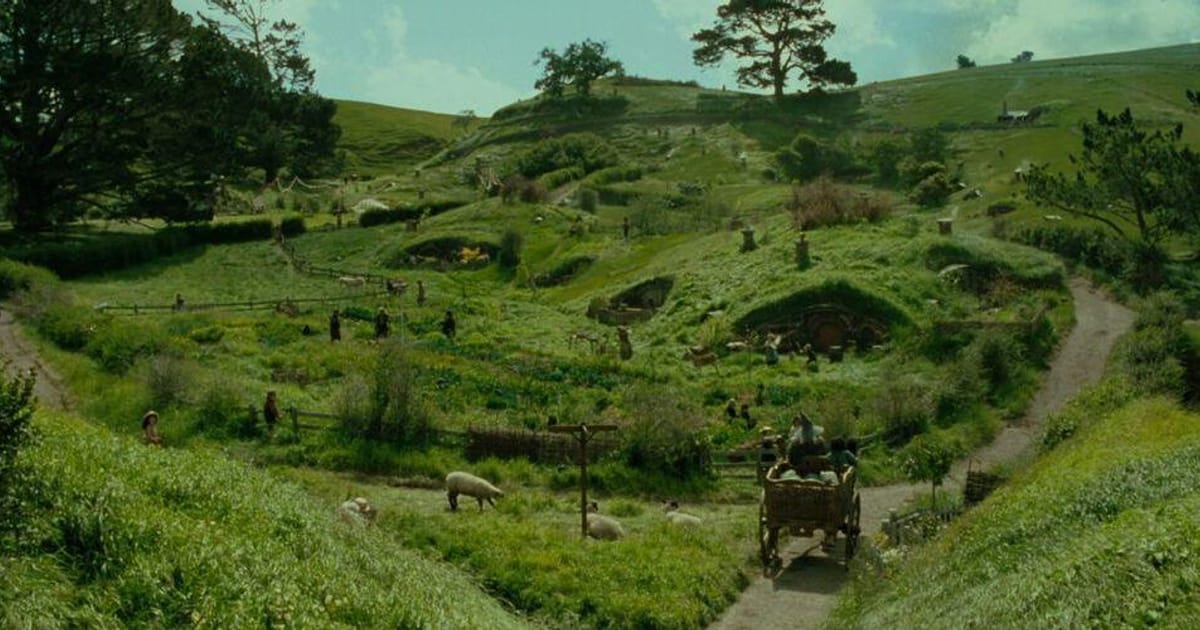
Frodo and Sam relied on friendship, duty, and a memory of the Shire rather than magic. That memory of strawberries, trees, and light served as their armor.
The Technocrats want you to forget the Shire and believe that the metal tower is all there is. They want you to trade your birthright for a headset and a pod.
Do not accept the trade. The machine can count the stars, yet it cannot admire them. The machine can analyze a prayer, yet it cannot weep.
Keep your soul. Break the dam. Let the river flow.
“Some trust in chariots, and some in horses: but we will remember the name of the Lord our God.” (Psalm 20:7, KJV)